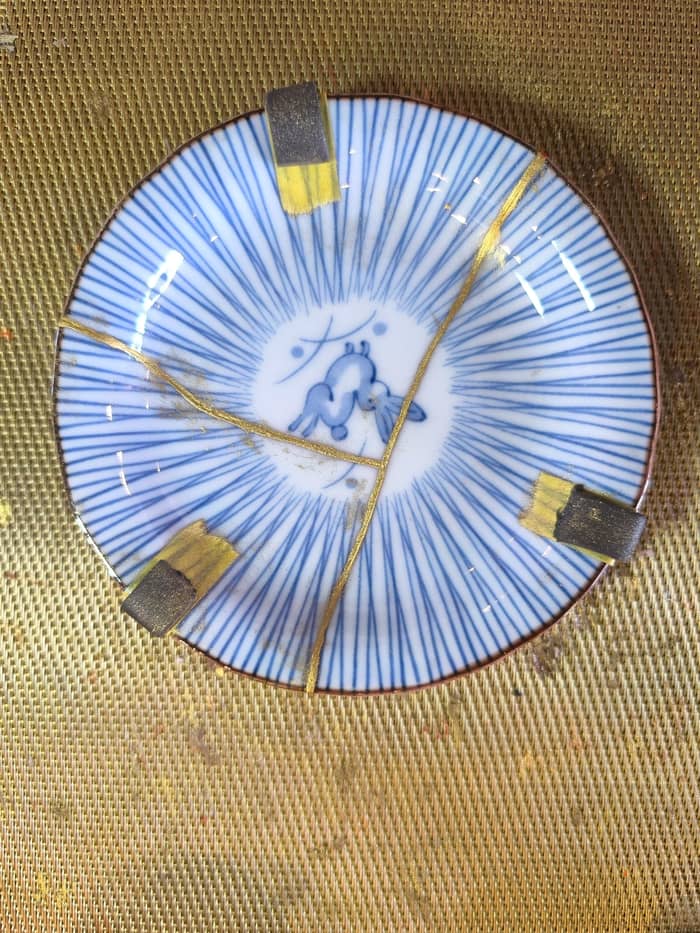
Free to start
Look closely
In a museum case
- WhereMuseum collections
- EffortNone
- You learnHow repairs raise value
Guide my choice
A brief reply
Kintsugi is the Japanese way of mending broken pottery with lacquer and gold, and the word translates to golden joinery.
Meaning in brief
Two questions, one class
Say how long you can spare and what matters, and a Kyoto class appears with its starting price.
Nearest to your plan
from $16
It runs 1 hour and has 1,112 reviews.
Nearest to your plan
from $105
It runs 2.5 hours and you leave with something to wear.
Nearest to your plan
from $18
It has 2,155 ratings averaging 4.93 and runs 1.5 hours.
Nearest to your plan
from $9
It runs 1.5 hours for a group of up to 10.
Nearest to your plan
from $18
It takes up to 16 people and runs 1.5 hours.
Kintsugi is the Japanese way of mending broken ceramics with lacquer and gold so that the cracks stay visible. This is what the word means, where the story comes from, what the repair is made of, and what the idea says about imperfection.
Editorial team, kintsugiworkshopkyoto.com · Updated November 2, 2026 · Roughly 6 minutes to read
The key points
The kintsugi meaning is usually given as golden joinery. A museum that explains it for its visitors says the technique applies gold, silver or platinum as a mending filler for broken pottery.1 Where most repairs try to disappear, this one does the opposite. The line where the bowl broke becomes a drawn line of metal, and the eye goes straight to it.
That reversal is the whole point. The New Orleans Museum of Art describes a ceramic-repair method, developed in Japan more than 500 years ago, that treats breakage as part of life's journey and shows the cracks as part of an object's beauty and history rather than something to disguise.2 The repair is not a confession, and it is not a patch. It is a decision to keep the object and to say so.
A practical way to hold the idea: imagine two identical bowls, one glued invisibly and one mended in gold. The invisible repair protects the object's appearance. The gold repair records its history. Neither is wrong, but only one of them tells you that something happened. Kintsugi is the craft of the second kind of honesty, done with enough skill that the record looks deliberate.
Parts of the repair
| Material or step | Its job | Side note |
|---|---|---|
| Urushi | The lacquer binder | Toxic, in the poison ivy family |
| Gold powder | The classic finish | Much costlier than brass powder |
| Brass powder | A practice stand-in | Used in a museum practice exercise |
| Silver, platinum | Other metals | Named beside gold as mending fillers |
| Damp box | Controls drying | The urushi sets over another week |
| Burnishing | The final polish | Makes the metal glossy |
Materials and steps as described by the museums and the Japan House instructor named in the sources.11,12,1,13,14
Almost every account of kintsugi history tells the same origin story, and it is worth knowing it as a story. It is said to begin with the shogun Ashikaga Yoshimasa, who lived from 1436 to 1490: his favorite Chinese tea bowl broke and was put back together with metal staples, and his displeasure at the clumsy repair pushed craftsmen to find a better way.4
The better way, in the telling, was to fill the cracks and patch them with layers of lacquer made from tree sap, finishing the last layer with a fine dust of powdered gold.4 The museum that tells this uses the phrase said to begin, and that wording is worth keeping. A neat origin attached to a famous name is the kind of detail that gets handed down because it is memorable, not because it was recorded.
What can be said with more confidence is about the period that followed. A Los Angeles County Museum of Art conservator notes that in the 16th century, when kintsugi was popular in Japan, it was a way for people to mend their pots instead of throwing them away.5 So the safe version is this: the craft is centuries old, it was popular by the 16th century, and a shogun's bowl is the legend that is told about its start.5
The binder is urushi, a lacquer made from the sap of the urushi tree, which grows mainly in China, Korea and Japan. It is toxic, it belongs to the poison ivy family, and it irritates the skin and throat of sensitive people.11 The same lacquer is the basis of Japanese lacquerware, which is why a kintsugi artist is often a lacquer artist first.
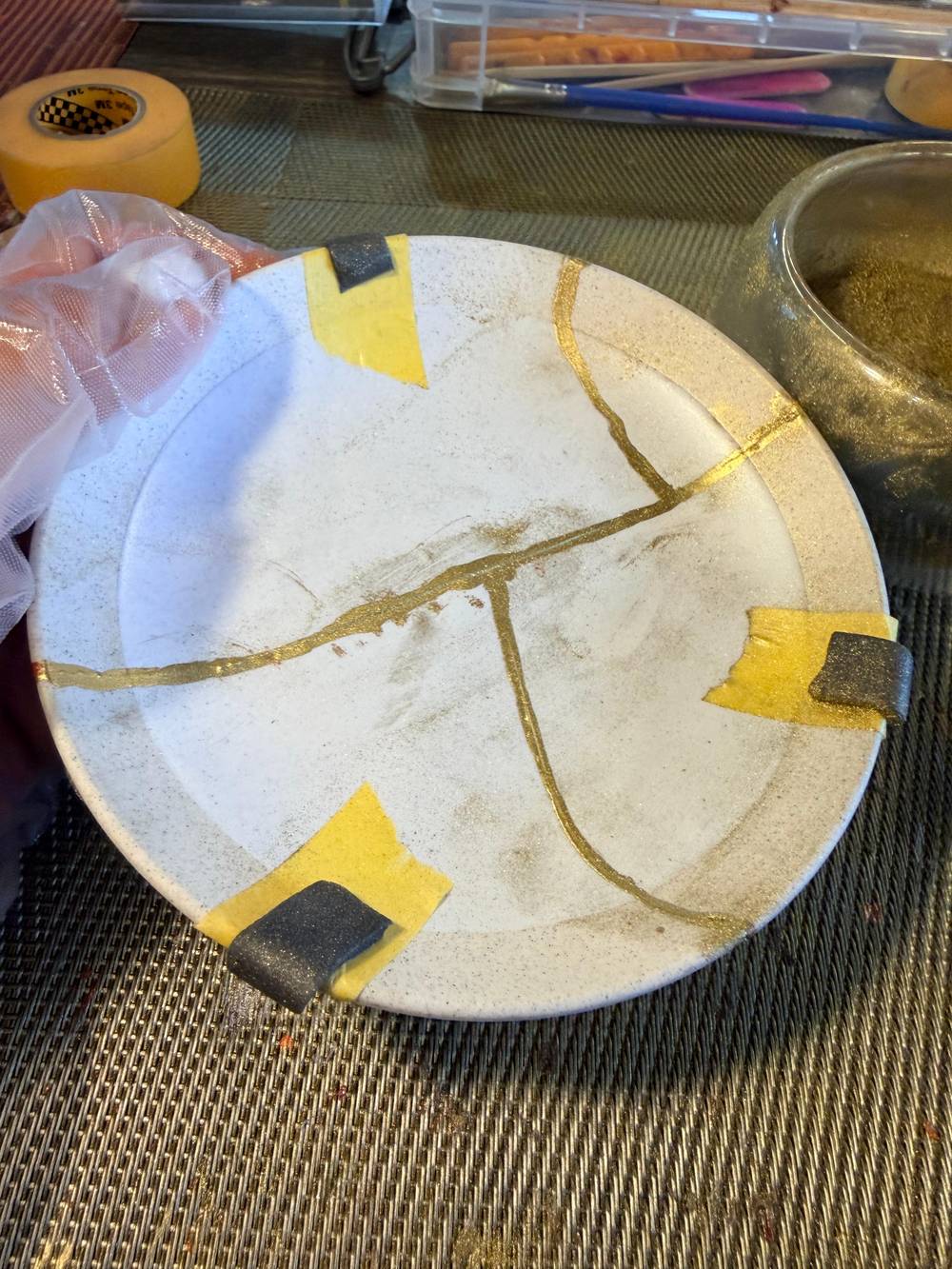
The metal goes on while the lacquer is still tacky. In the traditional method the powder is applied before the urushi has completely dried, and the piece sits in a sealed damp box that controls the drying.17 The urushi then needs another week in a humid chamber to set completely, and the final step is burnishing with a smooth tool, which aligns the metal particles and makes the gold glossy.13,14
Gold is the classic metal, but it is not the only one. Gold powder is much more expensive than brass powder, and museum conservators have used brass for practice exercises.12 That matters for the visitor who joins a class: the powder in a short beginner session may be brass, and the lacquer may be adapted for speed. It is a fair thing to ask, and a good studio will answer without embarrassment.
Three ways to meet it
Free to start
In a museum case
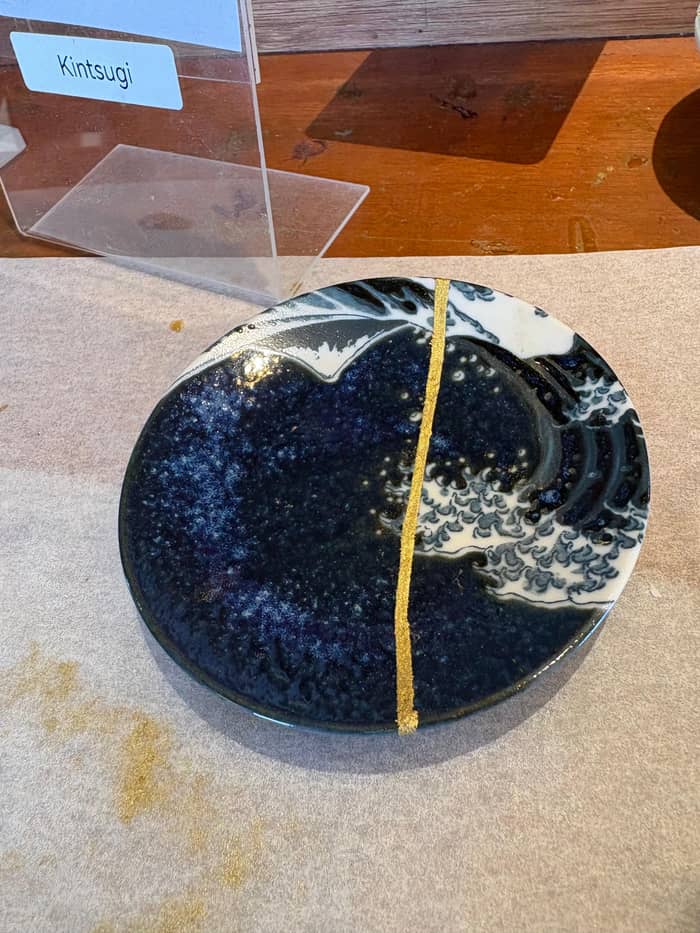
Learn by doing
In a Kyoto class
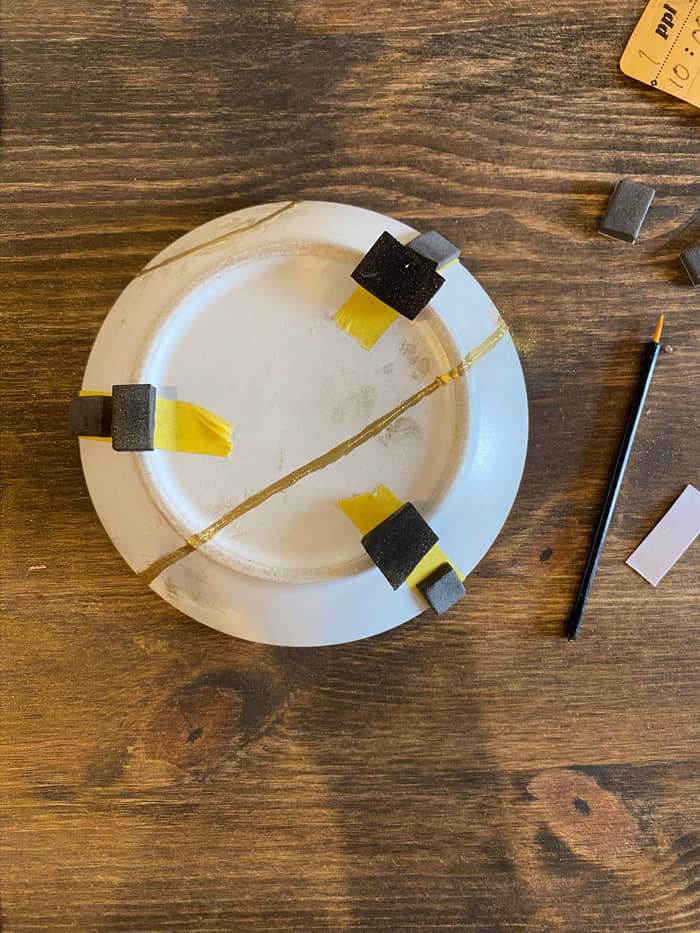
Slow path
A cup at home
Kintsugi is often called more than a craft technique. The New Orleans museum describes it as a tangible display of the Japanese aesthetic philosophy of wabi-sabi: the appreciation of imperfection, admiration for simplicity and acceptance of transience.15 That sentence has been repeated so often that it can sound like a slogan, so try it on a real object: a cup that has been dropped and mended says that things wear, break and carry on.
There is a market logic to it as well. In historic ceramic collections, a kintsugi repair raises an object's monetary and philosophical value.8 A bowl that was loved enough to be mended in gold is, in effect, certified as loved. Museums that hold such pieces treat the repair as part of the object's biography rather than damage to be explained away.
Keep a sense of proportion. The philosophy is a reading that grew up around the craft, and people reach for it in different moods. You can enjoy kintsugi purely as a skill, as a form of slow handwork, or as a visual language for resilience. A good class does not require you to adopt any of these. It only requires that you hold a brush steady and look closely at a crack.
Try it yourself
Enter your party size and compare three Kyoto classes.
3 sessions compared
Enter your party size and compare three Kyoto classes.
≈
View≈
View≈
ViewEach total uses the lowest from price on its listing, converted by the ECB reference rate; the exact amount is fixed at checkout.
Dates that matter
Fifteenth century
The shogun Ashikaga Yoshimasa lived from 1436 to 1490, and kintsugi is said to begin with his stapled tea bowl.4
16th century
Kintsugi was a way for people in Japan to mend pots instead of throwing them away.5
Seventeenth century
The potters Ninsei and Kenzan were at work in Kyoto in the 17th century.6
2015
Two Kyoto lacquerware artists demonstrate kintsugi in a Pitt Rivers Museum video.7
Today
Museums keep kintsugi pieces in their collections, and Kyoto studios teach visitors the basics.8
Kyoto matters here for practical and cultural reasons. Kyo-shikki, Kyoto lacquerware, has technology that was established in the Nara period, with master craftsmen appearing in the 16th and 17th centuries, and it became popular together with the tea ceremony.18 A craft that depends on lacquer and a culture that prizes tea bowls are the same soil that kintsugi grew in.
Kyoto's own pottery adds the other half. Kyoto ceramics were produced in the Nara and Heian periods and became a production center in the Azuchi-Momoyama period, and Kyo-yaki and Kiyomizu-yaki are known for their variety of technique and clean beauty.19 When you repair a bowl in a Kyoto studio, you are working in a city where both the lacquer and the pottery have long local lineages.
The craft is also still demonstrated by Kyoto people. In a 2015 video from Oxford's Pitt Rivers Museum, the Kyoto lacquerware artists Shimode Muneaki and Sato Takahiko demonstrate kintsugi, a time-consuming and delicate process with lacquer and powdered gold.7 Their work is why 'learn kintsugi in Kyoto' is not a marketing slogan but a real way of meeting the craft close to its sources.
Video
mono Japan on YouTube · Nothing loads from YouTube before you press play.
More than merely a craft technique, Kintsugi is a tangible display of the Japanese aesthetic philosophy of Wabi-sabi, the appreciation of imperfection, admiration for simplicity, and acceptance of transience.
Checklist
Visitor classes exist so that a beginner can feel the craft. The most-rated Kyoto class runs 1.5 hours, takes up to 10 people, and has you repair cracked or chipped ceramic pieces with lacquer and gold powder under an instructor's guidance. It carries 2,155 ratings averaging 4.93, so it is not an obscure offer.
Be realistic about the ceiling. A Los Angeles museum conservator says it takes a lifetime to become a master of kintsugi.16 A class gives you the principle, the tools and a finished piece, and a taste of how patient the real thing is. A beginner session at Japan House London likewise used shortcuts so that newcomers could complete a piece, as an accessible introduction.20
If you want to go further, newer materials have made the craft accessible to learners outside Japan, according to an instructor who trained with Kyoto lacquerware craftsmen.21 That means a class in Kyoto is a beginning, not an endpoint. Pick one for the experience, take the piece home, and look at every cracked cup in your kitchen a little differently from then on.
FAQ
The word translates to golden joinery, and the technique uses gold, silver or platinum as a mending filler.1
Japanese artists developed it more than 500 years ago.2
It is said to begin with Ashikaga Yoshimasa, who lived from 1436 to 1490.4
It is made from the sap of the urushi tree, is toxic and irritates the skin of sensitive people.11
It includes admiration for simplicity and acceptance of transience.15
Beginner classes use shortcuts so that newcomers can finish a piece.20
The most-rated class runs 1.5 hours.
Sources
Keep reading
A question about the class? A person answers here.